
How to Read a Hemp COA (Certificate of Analysis)
Why This COA Guide Matters
Shopping for hemp in Charlotte is easier when you know how to confirm what you’re buying. A Certificate of Analysis (COA) is your proof. This lab document confirms whether a hemp product is legal under North Carolina law and safe for use.
Many sites explain only one piece of a COA. This guide combines all the essentials while also adding local context for Charlotte, North Carolina. By the end, you’ll know how to read any hemp COA with confidence – whether you’re looking at a bottle of CBD oil, a pack of gummies, or THCa flower.
The Basics: What a COA Tells You
When you first open a COA, it can feel like a technical lab report. But at its core, every good COA covers a handful of critical elements that protect you as a shopper. These elements give you the reassurance that your hemp product is legitimate and compliant.
– Product identity: Matches the batch or lot on your label.
– Potency: Lists CBD, THCa, delta-9 THC, and sometimes minor cannabinoids like CBG or CBN.
– Safety: Screens for pesticides, solvents, heavy metals, and microbes.
– Legality: Confirms delta-9 THC is ≤0.3% on a dry weight basis (the hemp standard in NC).
– Authenticity: Shows testing was done by an independent, accredited lab.
If a COA leaves out one of these basics, you don’t have the whole picture. Understanding each of these categories gives you the confidence to judge whether the product in your hand is worth your trust.
Step 1: Match Product and Batch
The very first step is to verify that the COA belongs to the product you’re buying. Without this, nothing else in the report matters. This detail is often overlooked by new customers, but it’s one of the simplest checks you can make.
– Batch or lot number on packaging = batch number on COA.
– Product name, strength, and type align (for example, “CBD Oil 1000 mg”).
– Date of test is recent (preferably within 6–12 months).
If the numbers or names don’t match, the COA could be recycled from another product or batch. And if the report is more than a year old, you’re not seeing a reliable snapshot of what’s inside the product you’re holding today.
Step 2: Check Potency (Cannabinoid Profile)
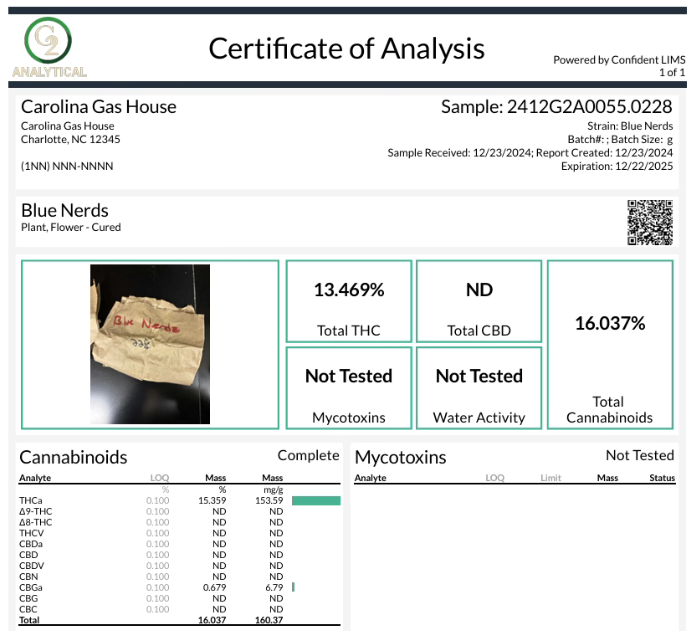
The potency section is where you see what cannabinoids are present, how strong they are, and whether the product meets the legal definition of hemp. This is usually the most detailed part of the COA, and it’s where a lot of the value lies.
– CBD: Does the amount match the label claim?
– Delta-9 THC: Must be ≤0.3% to be federally and state legal.
– THCa: This turns into delta-9 THC when heated. Some COAs also calculate “Total THC” (delta-9 + THCa × 0.877).
– Minor cannabinoids: CBG, CBN, CBC, etc. Not always tested, but they add to the “full spectrum” profile.
Taking the time to study this section helps you avoid mislabeled products, understand the actual strength, and confirm that what you’re about to buy won’t cause legal issues in North Carolina. Resources like Texas Cannabis Company emphasize the importance of understanding this calculation.
Step 3: Review Safety Panels
Once potency checks out, safety is the next priority. A COA should show that the hemp was screened for harmful contaminants. Hemp plants absorb substances from soil, so these tests are not optional — they’re your assurance that the product won’t expose you to toxins.
– Heavy metals: Lead, mercury, arsenic, cadmium.
– Pesticides: Common agricultural residues.
– Residual solvents: From extraction (ethanol, butane, hexane).
– Microbials: Bacteria, yeast, mold.
Look for “ND” (non-detectable) or “Pass.” If an entire safety section is missing, as BakeBoxx Wholesale points out, that’s a serious red flag. Products with potency-only reports are cutting corners.
Step 4: Confirm Independent Testing
It’s not enough that the product was tested – it matters who did the testing. Independent, third-party labs reduce conflicts of interest and add credibility.
– The lab’s name and address should be visible.
– Accreditation statements (ISO or similar) add credibility.
– Reports without a lab listed or only from in-house testing are red flags.
Brands that highlight their independent labs, such as Wild Orchard Hemp, make it clear they take transparency seriously. If you can’t tell who tested the product, it’s best to walk away.
Step 5: Spot Red Flags
COAs should build trust, not raise new concerns. Many industry guides, such as Elevated Trading, call out the same set of warning signs.
– No batch number or mismatched product name.
– No date or an expired report.
– Missing safety panels (only potency, nothing else).
– THC results that seem “too perfect” (exactly 0.3%).
– Lab not listed or no independent credentials.
If you notice more than one of these problems, the safest decision is to look elsewhere for your next cannabis vape or other product. A good COA should feel like reassurance, not a guessing game.
Bonus: Terpenes and Extra Data
Beyond the basics, some COAs include extra layers of information. These don’t appear in every report, but they’re worth knowing about.
– Terpenes: Compounds that add aroma and influence effects.
– Moisture content: Shows how dry the material is.
– Mycotoxin tests: Check for toxic mold.
– QR codes: Link straight to the lab database.
These features show that a brand goes above standard requirements. Terpene profiles are especially interesting to shoppers who care about flavor and experience.
Glossary of Common COA Terms
Lab reports often include shorthand that can make them hard to read. Understanding these terms can make the difference between confusion and clarity.
– ND = Non-detectable (below the limit of detection).
– LOQ = Limit of quantitation (the smallest amount measurable).
– CFU = Colony-forming units (used in microbial tests).
– Total THC = Delta-9 THC + (THCa × 0.877).
– Pass/Fail = Whether the sample met safety thresholds.
With these definitions in hand, even the most technical-looking report becomes approachable.
North Carolina Legal Context
All of this connects directly to state law. Hemp products must contain ≤0.3% delta-9 THC by dry weight, which is why COAs matter so much. Marijuana possession remains illegal in NC, with penalties based on weight. Reviewing a COA carefully can help you prove compliance if questions ever come up. For clear legal outlines, see NORML’s North Carolina guide.